
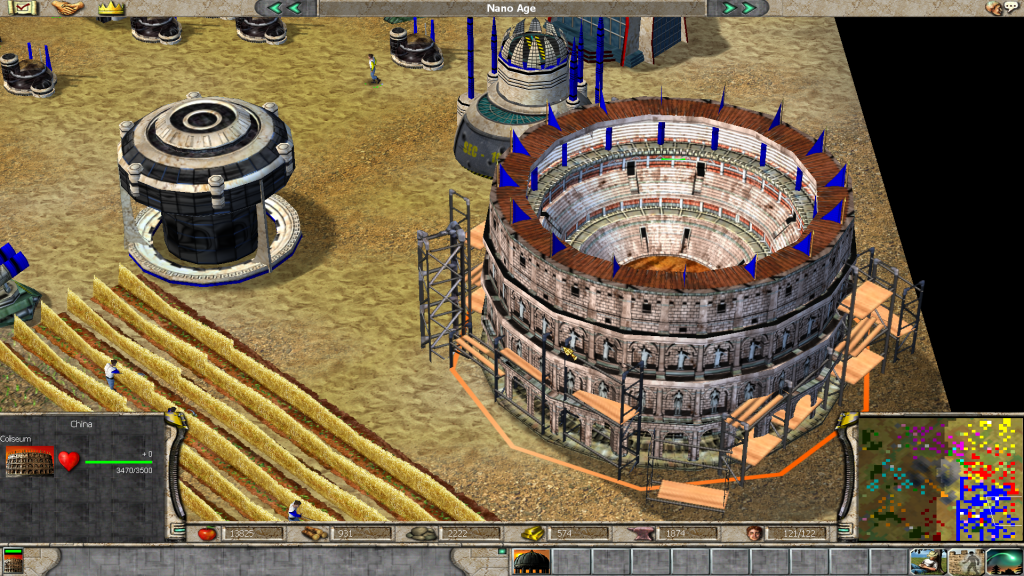
Starting in the Digital Age in Empire Earth, the architecture suddenly shifts to a futuristic style. The Capitol for instance, isn’t trying to replicate the St. Basil’s Cathedral in London now, but some theoretical capital in the future. Its architecture is rounded, like it belongs on some distant planet and not on Earth. The culture that it represents is one that worships efficiency over the idea of human culture. Compare that to the Colosseum wonder being built next to it.
The Colosseum was an expression of Roman culture using the technology they had in order to construct it. It also represented their many abstract ideas of how to organize their society. The Digital Age capital in Empire Earth is a representation of the technology overtaking the expression of human culture. What we see in the buildings in the future epochs is really a continuation of what saw beginning with the Modern Epochs; architecture is now functional. Now architecture is basically just housing technology within those structures.
Here is the great idea behind Cyber Labatory which is right behind the Colosseum; it isn’t about the structure which is mattering in here, its the technology which matters here. Gameplay wise, the Cyber Labatory is representing something new in military affairs in the game. These Cybers are made specifically to counter other Cybers not the remaining human units. This is Cyber on Cyber conflict not human.
This is the essence of the Nano Age.
Tech is more important than when we use it to make culture.
It is not surprising that the houses in the Nano Age do not have any distinctive cultural aspects to it. Art and Culture is subordinate to the interests of efficiency, or more specifically, how we use technology to interact with our epoch.
That is the essence of the Digital and more importantly, the Nano Ages in Empire Earth.
 My Game Reviews