
Civilization 7 is the worst game in the series. There are some who want to say that it has new ideas and not recycled ideas. I am guessing these are casual gamers or people who are easily swayed by marketing because this is basically SimCity Societies from 2007 in a Civ Game.
The issue is that the players who played the older games before Civ V have been seeing the changes and that it is becoming very much like Angry Birds and other forgotten mobile games, just a brand to put on mediocre gameplay and hide it with marketing.
The UI is terrible and when compared to Civ 1, it shows the generational changes and the malaise we are currently in this culture.
The Civ switching was a concern of mine earlier on and I see that Fraxis was lazy and put in a bunch of leaders who are not leaders but Great People.
The game does not have England in the game but hides behind a DLC and puts in a person, Ada Lovelace, who was not a political leader, phlisophical, or spiritual leader in any sense. The leader of England should be a King or Prime Minister. I would recommend King Charles II of the Restoration Era.
The Shawnee were put in the game for politics and yet Confucius can rule them. Do not use the CIV has never been about history. It has a tech tree which contains many of the most important technologies in human history. This is not a very good argument to using here.
The crisis system is lazy and does not provide context for what is happening. Having every Civ move into the same age is silly and makes the game too easy. There needs to be consequences to not being able to catch up in tech or economics. Having a reset does not make the game challenging. The Civ Switching doesn’t even stop the snowballing that they say they wanted to not have.
It is clear that the game has increasingly become attached to politics in America more and not just a game about history.
The map generation is terrible and worse than 20 year old games.
The positive reviews are people who generally enjoy simpler, easier games. While Microsoft is no saint of a company, they have made AOE 4 into a game that appeals to casuals and power users. They even encourage people to improve their tactics while also being a great platform for teaching history about multiple cultures, without being myopic about it.
Civilization 7 is the worst in the series. Civilization V was a strange experiment on launch but they did not railroad the player into 3 mini games.
In 2003, a spiritual successor to Empire Earth was released. It was known as Empires: Dawn of the Modern World and it is an intriguing game. Made by the same people who made Empire Earth, Stainless Steel Studios, it is game that refines Empire Earth by giving it a new coat of paint. That paint is quite effective and transforms Empire Earth into a lush if somewhat more shallow game.
Unlike Empire Earth 2, which sought to push the franchise into the direction of being more like Rise of Nations vs its original game, Empires takes what made Empire Earth successful and refines it.
In Empires: Dawn of the Modern World, every civilization has their own unique architecture and some even have unique structures.
Empires plays very similarly to Empire Earth. Much like many other RTS in that era, it is mainly about the military rather than the economics. Empire Earth 2 would have a much greater emphasis on economics. Empires in fact simplifies the resource mix in the game. Iron has been taken out of the game. Population is not dependent on technology anymore and is simply built through houses. This simplifying makes the game easier to play though it lacks some of the depth of Empire Earth and especially the sequel, Empire Earth 2.
The game has beautiful reflections and water effects, especially when you consider that the game came out in 2003 and just two years after Empire Earth.
The game plays quite well and does not require reading a manual in order to learn is mechanics.
Some civilizations are easier than others. England for example, allows you to build any building without need the citizen to participate in the process of building. England also can build mining camps on stone and gold mines in order to mine them automatically without needing citizens at those camps to been getting the resources with their pickaxes.
Empires has a neat gameplay mechanic where roads are automatically built whenever you build a building close to another one, making the game seem more stylistically interesting than Empire Earth.
The civilizations are all unique but I think they sometimes make the game too easy, especially on some maps and difficulty settings.
The game has some really beautiful skyboxes.
What is remarkable about this game is its skyboxes. They are truly beautiful to look at in this game. While the game has some of those angular landscapes, I remember that it is a early 2000s game and not Oblivion Remastered with Unreal Engine powering it. This is the charm of these games that were made in that era. This same sentiment is why Oblivion Remastered managed to sell so many copies within its release.
The small details in Empires is what makes it special to me. Look at the clock on the England Town Center. It is not simply static, it actually moves
What the game is probably best at it is graphics, most importantly the presentation of those graphics.
Graphics are much more effective when you have good presentation of how the graphics work in a game. Instead of just plastering good graphics everywhere, using them effectively is what makes a good game a great game.
Empires is that great game and while it may more simplistic, the character and charm of this great game can be found in those graphics.
In the screenshot above, you can see English Town center towards the left of the screen. The hands of the clock in the tower actually move in the game. Other nice touches are that when a house or fortress is garrisoned with citizens or soldiers, you will see a flag appear next to that building. Such visual presentations were also seen in Empire Earth 2.
The game has many map types and it looks better than the original Empire Earth, especially with the interaction of the water coming onto the beaches.
Empires is a very nice early 2000s game in its landscapes. The greenery of the forest one is better than the desert one in my opinion, but they are both one of the game’s strengths.
In the screenshot above which takes place on the Peloponnese map, which is a unique map type one does not see often in video games. It is a map type which simulates Greece’s most famous area which is filled with highlands and seas on both sides. Here you can see two vicars and three longbowmen on the top of a mountain near a sea. This is the game’s graphics at its best. Unlike Empire Earth’s graphics palette, the greenery in this game looks more appealing. This is quite impressive considering that the game came out only roughly two years after the original Empire Earth.
The graphics close up in this game are truly beautiful and have like wine. Unlike Empire Earth, they are not too rough.
Another nice touch in this game is that the roads are automatically built between buildings. Such little additions are what gave Empires its character back when it was released. Unlike Empire Earth, I feel like its 3D graphics are nice and cleaner to look at and that is why I think that some players prefer playing it.
The coastline in this game is probably one of the strongest in aesthetical presentation I have seen in this era of RTS games.
Empires: Dawn of the Modern World is a magnificent game that is well worth playing in 2025, especially with the dearth of RTS games on the market now. It is a fun game with just the right amount of complexity to keep casual players interested in the gameplay and coming back for more experiences.
The Original Empire Earth came out in a time when expansion packs were still packaged in boxes. The cover of the Art of Conquest expansion features a Roman legionary, probably a centurion in his armor.
Inside the game, there was inclusion of a strange aspect to the game known as the Space Age.
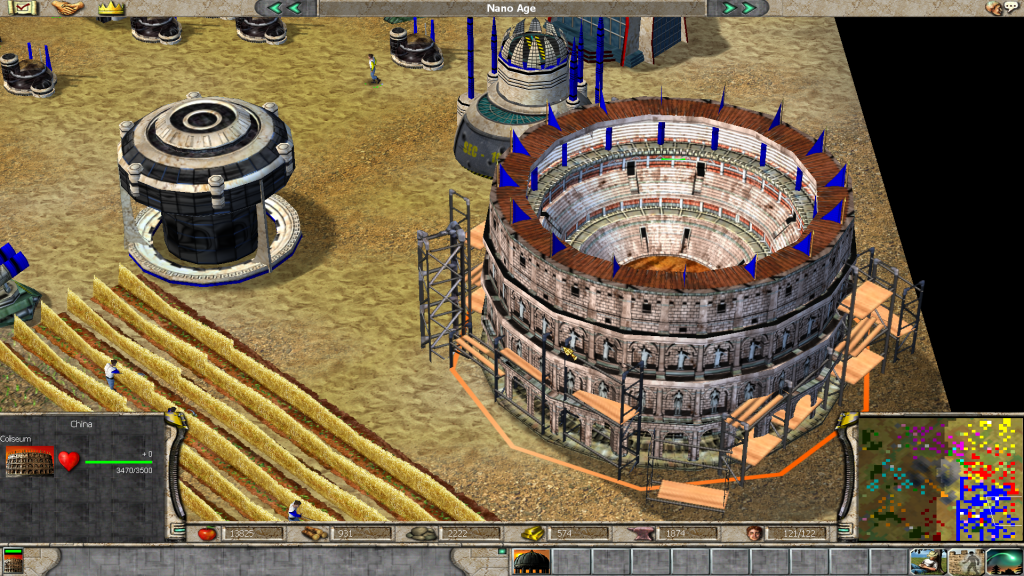
In this screenshot above, you can see the stars in the background, beyond the Space Age tower.
It is quite apparent that the developers were ambitious with this expansion. Whereas they could have spent the time putting more focus on fleshing out the various civilizations in the game, they spent it on adding an entirely new part to the game, namely space.
In some sense, it is clear Empire Earth’s engine just wasn’t up to the task of rendering space.
When one looks at the planets in Empire Earth, they look like floating pieces rock in some High Fantasy story that have been transferred onto the great vastness of space. In my opinion, it looks out of place here
Space in Empire is similar to water but there is a big distinction here. There are no resources available in space. Everything that you need has to be on the land parts of the map. This means that space is merely just a physical barrier, which separates you and your opponents.
The walls in the Space Age get an upgrade. In this age, they shimmer like force fields in Star Wars. Stylistically, they are not as imposing as the Laser Walls that appear in the Digital Age.
The Clunky nature of playing a 2002 game
I remember playing Empire Earth in 2002. I did not touch the expansion at that time.
Now that I am playing it with having more 20 years of foresight, I can see how old software is having issues playing on what would seem like a supercomputer in those early Aughts.
In the game that I was playing, the game was running slow as various robotic citizens were being added to my planet. It was clear that the game was not optimized properly for modern computers.
GOG.com has done a great service for bringing older games back onto the computers of gamers.
The Space Era in the Empire Earth: Art of Conquest expansion is still worth playing now.
What makes it exciting is that clunky integration of space and land into the game.
Empire Earth in its futuristic ages has something that the sequel does not have; it simply seems more holistic.
In some sense, I can understand why Empire Earth is still more popular than the sequel. That ability to build move units and build buildings wherever you want is important aspect of the game.
As I play the Space Age of Empire Earth: The Art of Conquest, I reminded of how games were once affordable and were actually worth the time and money you spent on them. That is why Empire Earth still holds a speical place in my gaming catalog.
Sometimes, a bit of clunkiness goes a long way to building character.